
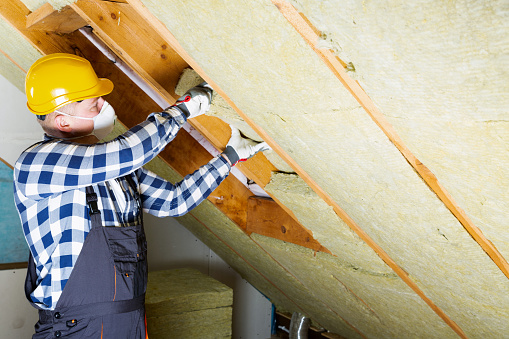
It is common for people to interchange the terms “insulation” and “spray foam insulation” for each other. However, they are not one and the same, though the two terms are related. The aim of this article is to compare both terms by highlighting the differences and similarities between them. The term “insulation” is an umbrella word, and can be defined as a material used to interpose or fill spaces such as gaps and crevices in a building, in order to prevent heat and energy loss. Insulation thus exists in various types and forms, with the individual application of each dependent on the purpose and building type.
Building insulations may be thermal, acoustic, fire-proof or impact-resistant. Most materials used in buildings have been adapted to suit more than one of these purposes such as the spray foam insulation, which serves as a thermal, air, and water barrier. In some cases, it may also serve as a sound barrier. Spray foam insulation is the use of spray foam, a chemical product made from the mixture of isocyanate and polyol resin, which expands upon spraying, to seal wall, floor and ceiling gaps. Spray foam is also utilized to block out cellars, vents, basements, window slopes, attic hatches, wiring holes, and even vehicle bodies. It is one of the many forms of insulation and its popular for being cost-saving, eco-friendly and durable.

While spray foam insulation is particularly specific to the use of spray foam as a building insulation, insulation on the other hand, may mean other forms of building and electrical insulation. However, there still exist materials which are used specifically for particular insulation purposes such as:]
i. For thermal insulation: Thermal insulation reduces unwanted heat loss, thus reducing the energy and HVAC demands. Materials commonly used for the purpose thermal insulation include but are not limited to:
- Cellulose
- Spray foam
- Wood fiber
- Cement
- Vermiculite etc.
The low rate of thermal conductivity in these materials allow for their perfect use as thermal insulators.
ii. For fireproofing: The frequent occurrence of fire hazards led experts to innovate ways to keep homes and buildings safe from damage. Materials and equipment used include:
- Concrete linings
- Gypsum-based plaster
- Asbestos etc.
Spray foam insulation is not suitable for protection against the destructive effects of fires as it is combustible, hence, with regards to fire protection, spray foam insulation is generally ineffective.
iii. Electrical insulation: In homes, there is always the risk of an electrical malfunction which may result from a short-circuit or a bad connection. In order to prevent these malfunctions, electrical instruments and equipment such as wires, cords, rods etc. are fitted with casings to prevent the passage of electrons between external electrolytes such as water, and of course, the blood in our veins. Electrical appliances are also equipped with fuses and other apparatus to prevent such hazards.
Major Forms of Building Insulations Asides Spray Foam Insulation

1. Fiberglass Insulation
This form of insulation is very common, alongside the spray foam insulation. It makes use of a mixture of plastic filaments mixed with glass, and spun into fibers. This is unlike spray foam which is made from isocyanate and polyol resin. Your choice between the two as said before, depends on the type of building or area intended to insulate. The 2.2 per inch R-value of the fiberglass insulation is greatly lower than that of the spray foam insulation which is about 5.5 per inch for the closed cell type, and 3.5 per inch for the open cell type.
Hence, the spray foam insulation is more long-lasting (up to 30 years) and cost-saving than the fiber glass insulation. However, the spray foam insulation is more expensive to install than the latter, though it requires no further renewal or maintenance. Also, the fiberglass insulation is easier to install, as it can be done personally. However, the spray foam insulation requires expertise.
2. Foam Board Insulation
Foam board insulation is best for insulating floors, unfinished walls and ceilings. Usually made from polystyrene, polyurethane or polyisocyanurate, they reduce the amount of conducted heat and can be installed independently. The R-value of foam boards range from 4 to 6.5 per inch. However, the spray foam insulation is still more advantageous than foam boards in durability.
Others include blanket batt and roll insulation, concrete block insulation, loose-fill or blown in insulation etc.
Pingback: Benefits of Spray Foam Insulation? - Insu4u